Friday, July 5, 2013

Lions and Tigers and Bears, Oh My!

Mrs. Sissom
Well, we did not actually see lions and tigers, but there were two grizzlies and a black bear. The sights from today were amazing such as bison crossing a river, a blue heron rookery, an eagle and two ravens having a power struggle, a huge bull elk, and white pelicans.

Bison crossing the river

Bison

White pelican
Brad, our guide, also gave us an overview on the geological history of the park. The park began as a super volcano. Our drive started through the lodgepole pine area, continued into mountain meadows, and ended with thermals. The smell was not so great around the more acidic seeps, but the view more than made up for it.
Grizzly bear groupies 
Now, some of you are thinking our group is here to have fun and see beautiful sights. We are! However, our guide has given us so much information on why things happen and the effects of what happens that by the time we arrive back at our cabin, our minds are saturated. Over dinner, a discussion ensues about the information gained from the day. Everyone seems to have focused on a different aspect of the information.

My favorite three things from the day: 

A herd of bison ran to the Gardiner River and swam across with their bodies and  breath steaming. 

Their breathing and snorting could be heard from our location. 

The grizzlies!  

A little girl was whining about not being able to see the bears so our group offered her a scope to look through.  When she located the bear, her exclamation left no doubt to anyone that she saw him.

Thursday, July 4, 2013

The American Serengeti

Mr. Hancock
Wednesday our group had a very full day wildlife watching in the Northern Range of Yellowstone Park. Our seminar began at 7:00 AM and ended 5:30. We ate a brown bag lunch in the park. Our guide Brad Bullins, did a very professional job of enlightening us about Yellowstone wildlife. We drove through the massive park looking for interesting sights from the road. If someone saw an animal we were interested in studying Brad, our guide, pulled the 16 passenger bus to the side of the highway, and we all exited the bus equipped with binoculars, cameras and high powered spotting scopes. Brad taught us how to predict where we would be likely to see animals as well as using his experience and intimate knowledge of park's wildlife. Our group all agreed it was a day well spent, and we all have new ideas to bring back to Cushing Middle School to use in our classrooms.
Using spotting scopes

A red fox, an entire Osprey family, Rocky Mountain bighorn sheep, mountain goats, pronghorns, elk, bison, coyotes, bluebirds, magpies, red tailed hawk, Canadian  geese,  ground squirrels, weasels, trout, a stonefly hatch, least sand pipers were sighted.

Front paw of a grizzly bear (big claw marks)

Back paw of a grizzly in some sandy soil
We also learned how to discover and interpret animal tracks. We saw black bear and grizzly tracks as well as numerous smaller animal tracks. Our guide instructed us in field wildlife management techniques such as reading animal browse signs, discovering beaver activities looking for rub signs and using insect activity in the creeks and rivers to help determine the health of the streams.
Big Horn sheep
We each had a favorite sighting. Mine was watching a family of mountain goats clinging precariously to the side of a huge peak. Mrs. Nordquist has said hers was watching stone flies hatch on Soda Butte Creek, a rushing mountain stream, where we ate our lunch. Mrs. Sissom liked the goats on the Northern Range, too. But, she also said the Osprey family feeding their young was a very impressive sight. Mr. Hawkins liked tracking, discovering, and measuring grizzly bear tracks. He was good at it.

We start another day at 5:30 tomorrow morning. Our guide will use his experience and knowledge to lead us to different areas of this vast and beautiful place. We are still hoping for a bear and maybe even a wolf tomorrow.

Tuesday, July 2, 2013

Are We There Yet?

Sharon Sissom
Six adults have traveled 1,197 miles over four days’ time in one vehicle, journeyed through 6 states, and moved to different accommodations each night which means packing and unpacking the automobile and still like each other.  Teaching has definitely taught us love, compassion, and patience for others. Driving as much as we have seems like torture, but the wildlife is abundant and the sights are amazing. How can you complain when the Rocky Mountains are in sight to our left and The Badlands on the right? That was an awesome experience.

We arrive at Yellowstone tonight and our excitement is building. After running into some Oklahoma people at Mount Everest who had just left Yellowstone and shared their pictures of a grizzly bear and some elk with us, we cannot wait to get there. I personally want to see a grizzly bear and some wolves badly, but am also terrified.

Devils Tower
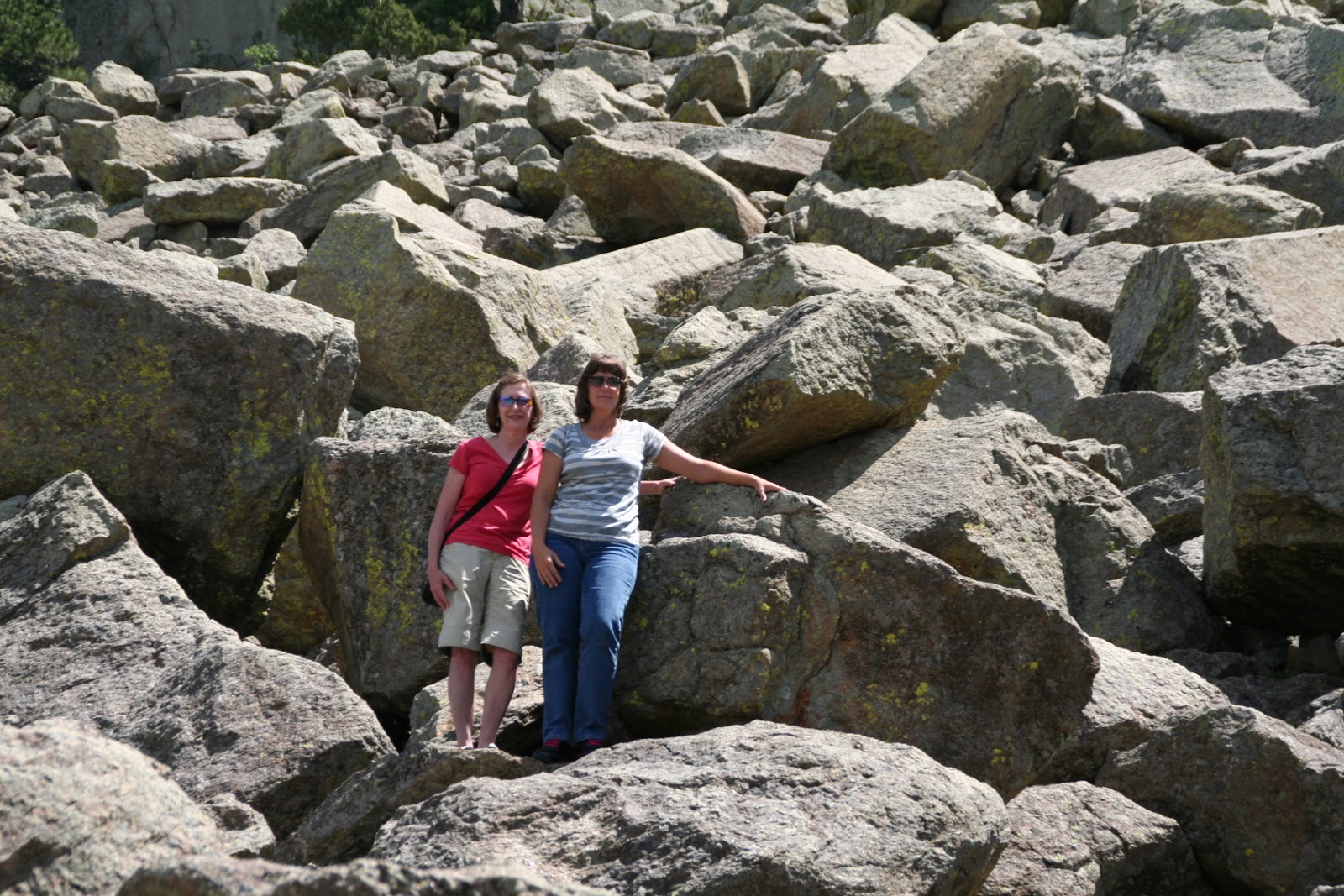
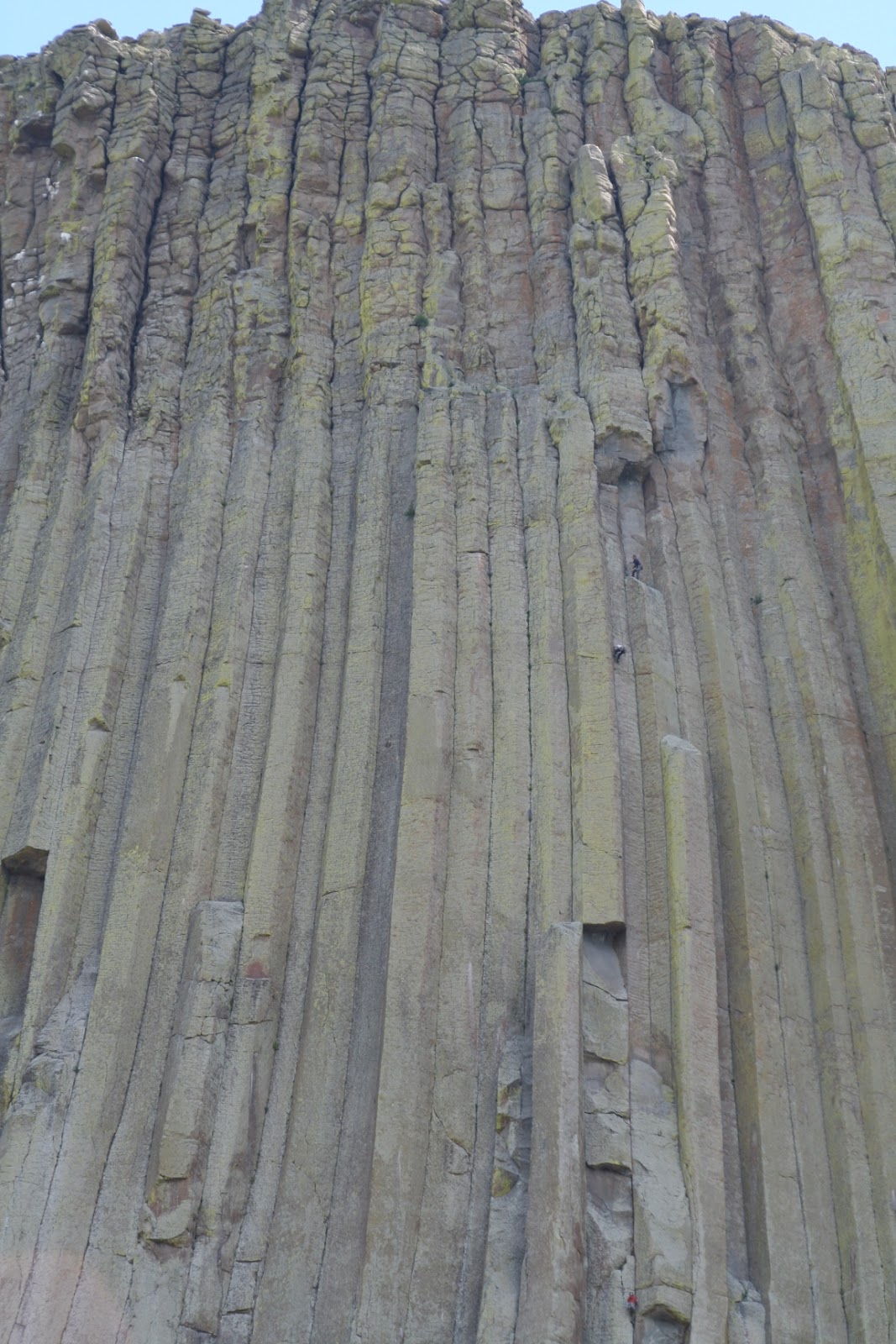
As we visited the Devils Tower today, the big discussion was about how we could possibly explain the size of the geological formation to students when having a hard time grasping that concept in person. While we were at the tower, we watched three guys climb the immense wall. It was amazing to see how small they seemed against the 1,200 foot formation. Kent, Tracy, and I walked around the base of the formation which was approximately 1.3 miles. It seemed much longer.
A little bouldering at the base of Devils Tower
Can you see the climbers on the tower?
Opinions vary on how the tower was formed. Some believe it was formed by the forcible entry of magma into or between other rock formations. Others suggest it was a volcanic plug stuck in the neck of an extinct volcano. Another theory is that the Devils Tower is a stock which is a small intrusive body formed by magma, cooled underground, and was later exposed by erosion. No matter how it was formed, it is impressive.


The legend of Devils Tower has been passed down through time by Native Americans. It is said that seven small girls were chased by a bear. The rock elongated itself upwards out of the bear’s reach causing him to jump and claw the sides of the rock leaving deep grooves in the rock. After visiting the tower today, I can honestly say, it looks like the legend could be true.

Monday, July 1, 2013

Treasure Above and Below the Ground

Mr. Hawkins

Wind Cave National Park 
We began our day with a 7:30 rise and shine.   We traveled to Wind Cave National Monument to view what it had to offer both above and below ground.   We arrived in time to do one of the early morning tours.   We were directed to the original opening of wind cave which surprisingly was only big enough for a small boy to fit through.  We were instructed by our park ranger on duty that the cave exhibits a barometric wind.   When the air pressure outside decreases the wind blows out of the cave.  On a high pressure day the wind will blow into the cave.  Our ranger explained to us how important it is not to touch the cave walls because oil on the human body can destroy the processes that lead to cave formations.  The ranger then led us down a staircase into the cave.   The stairs descended quickly and we soon found ourselves 200 feet below the surface. 

Frostwork

Boxwork
 Two of the main features we saw in the cave are boxwork and frosting.   Boxwork is the result of minerals, gypsum that expands over time, causing cracks in the rock structure followed by the cracks filling with calcite.  Later when erosional processes take place the softer rocks are eroded away leaving the box-like structures found in the cave.  Think of boxwork like looking up at many empty box sides crisscrossing one another only the boxes are all empty.   Frosting is caused by a similar process like the formation of stalactites and stalagmites.   Wind cave does not have either of these but does exhibit frosting occasionally.  Think of frosting as a rock structure that looks like the ice that forms on the walls of your refrigerator over time.  It has many small points that come out of a central mass.

 There is no animal life within wind cave.   All life that does exist is microscopic.  We did observe a few mold spots as we travelled.  There were no bats in this cave.   There was very little water present in the cave at this point.  Most of the passages in the cave were the result of acidic water flowing many thousands of years ago under the surface.

Wind cave was the 7th National Park to be designated.  It all began with the discovery and mapping of the cave by a young teenager by the name of Alvin McDonald.  Alvin mapped most of the cave with a simple candle bucket and used string to find his way back out when he explored.  Alvin later travelled to the World’s Fair in Chicago in order to raise interest in the cave as a possible money making attraction for South Dakota.  Alvin died when he became sick and returned home to continue mapping the cave.  He refused to quit and it caused him to die a premature death.   The walkway inside the cave is about ¼ of a mile long.  It took workers from the CCC several years to build the walkway using inner tubes filled with concrete that weighed 90 lbs. each and walking them in one at a time.   We were told that a 90 pound load of concrete amounted to only 1 inch of pathway along the trail.   Imagine the immense work that went into play to provide the path that we explore today.   Wind cave consists of over 140 miles of pathways that have been confirmed and mapped below the surface.   There are still parts of the cave that have not been explored.  It is one of the largest continual caves in the world.   There is a water aquifer located below the cave passageways that holds cool water at about 49 degrees.  The average cave temperature above this aquifer including the passageways is about 59 degrees F.

One of the things that people planning a visit to wind cave may not realize is the treasure found above the ground.   Wind cave is home to abundant wildlife.   There is a healthy buffalo herd and we saw large buffalo bulls sunning and even saw one in a buffalo wallow.   This is a place where they scent mark and roll in the mud to control insects etc…..   We went on a nature trail hike within the park and saw elk scat, or poop, and saw a doe mule deer at about 60 yards foraging on the hillside above the trail we were on.    We were able to approach really close to a pronghorn buck with nice horns within the park and got several nice pictures of prairie dogs.   Wind cave shows a cross-over between grassland ecosystems and the Black Hills Forest area.   The bison benefit from the grass and are able to find ample cover in the forested undergrowth when needed.

We learn to appreciate the work of those who have gone before us and the insight of our past Presidential leadership in recognizing the importance of preserving for future generations the beauty of this great land that we call home.  Without regulation Wind Cave and many of our National Park areas would have been desecrated by eager souvenir gatherers who lack the importance of preserving the experience for those to follow.    We must learn to appreciate beauty without detracting from it.   We must appreciate how fragile our ecosystem really is and that man does not always have the greatest wisdom when it comes to changing what nature has designed naturally.  We witnessed many pine trees that have died recently due to boring weevils that were introduced into areas where they were not native.  This is a sad scene to look at.  What once was a beautiful mountain hillside has now turned into a dull brown graveyard leading to worse problems like erosion.  It takes a lifetime to grow a tree to the stature of those in our national parks.

We have already had a treasure trove of experiences on this trip that have broadened our understanding.  We sincerely appreciate the support we have received from the Funds For Teachers program and look forward to what is to come tomorrow.   We can hardly wait to get to Yellowstone.  

There will be more to come in the following days.   Bear country, wolf country, elk country….yeah!!!!!!

Sunday, June 30, 2013

Day 1

The World's Largest Porch Swing in Hebron, NE
The teachers become the students now. Our Fund for Teachers Fellowship has begun. Day 1 required a 12 drive getting us closer to Wind Cave, the first National Park on our study tour. We couldn't pass up the World's Largest Porch Swing in Hebron, NE or Carhenge in Alliance, NE for a little bit of fun.
Carhenge in Alliance, NE
Today we will take two cave tours and learn about the geological reasons for the unique features in one of the longest caves in the world. We will also want to know if  White Nose Syndrome is affecting the bats at Wind Cave.

Thursday, June 27, 2013

What Happens to the "Lucky" Problem Bears?

Mr. Hancock
One of the questions our team will explore in Yellowstone is how humans and bears can share the Greater Yellowstone Ecosystem safely. Bears are wild animals and have the potential to be dangerous. We will learn how the Park Service has come to understand that in order to keep humans safe, humans must let bears search for their own food in the wild because if bears get used to human food they may become nuisance bears. Some bears who get used to human food even become aggressive and threatening in order to obtain more human food. Unfortunately, it is often the bear who suffers the consequence. "A fed bear is a dead bear." So educating park visitors is very important. 

The Grizzly & Wolf Discovery Center is another group who is trying to make sure humans understand how important their own behavior is to their safety and the bear's. It is an AZA accredited Not-for-Profit, wildlife park and educational facility whose primary mission is to provide visitors to the Yellowstone area an opportunity to observe, understand and appreciate grizzly bears and gray wolves. http://www.grizzlydiscoveryctr.com/

Some lucky "problem" bears get to live out their lives in the center. The bears at the Grizzly & Wolf Discovery Center had to be removed from the wild because they were becoming dangerously comfortable around humans. Their stories help share a valuable lesson of how people can take the proper steps to ensure bears stay forever wild.

Wednesday, June 26, 2013

What Causes the Winds in Wind Cave?

Mr. Hawkins
Barometric pressure, also called air or atmospheric pressure, is the pressure exerted by the weight of air over a given area of Earth's surface. At sea level the air pressure is about 14.72 lbs per square inch. This pressure is measured by an instrument called a barometer.

At sea level (the level of the ocean's surface) gravity is strongest and air pressure is greatest. Because gravity weakens as you go up, air pressure is lower at higher altitudes. However, the barometric pressure at any given location on the earth is constantly changing. Temperature differences lead to pressure differences.Those changes produce winds. Winds will not blow unless there is a pressure difference from one place to another. The greater this difference in pressure the faster the wind.

Because Wind Cave is so large and has a lot of space, it also has an air pressure system. That air pressure system is always working to be equal to the air pressure system on the surface. Air travels from high pressure areas into low pressure areas. This is referred to as cave breathing. High pressure on the surface occurs on cool clear days. Low pressure is associated with storms. This causes the wind to go into the cave on high pressure days and out of the cave on low pressure days or bad weather days.

Barometric airflow through the natural entrance of Wind Cave not only gave the cave its name, but also provides an opportunity for determining the approximate volume or size of the cave passages. Monitoring and recording the barometric airflow through the cave natural entrances help us understand the volume of air in the cave and that can be used to calculate the total volume of cave passage. By using the amount of air that comes from the cave we can determine the volume of space in the cave. At this time we have determined that we have found less than 10% of the cave.

midlandsmoggy, Feb 2012 via Trip Advisor